
Your Tenant's High Utility Bill Is Your Problem
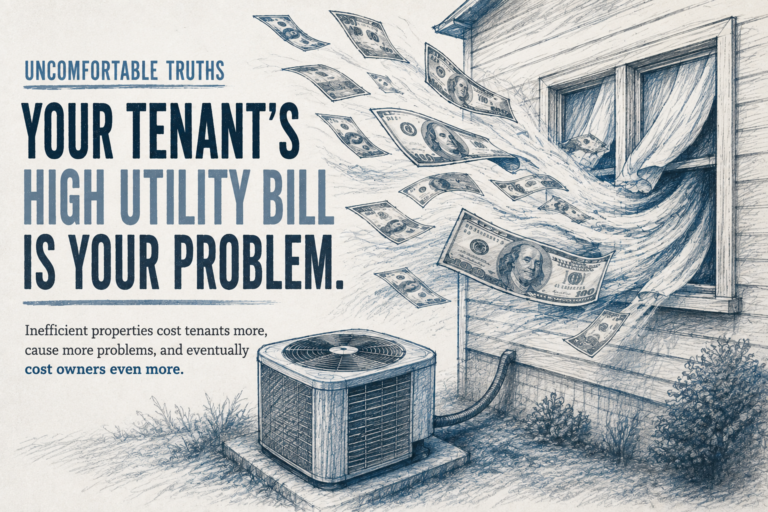
The tenant may be responsible for paying the utility bill, but that does not mean the cost of operating your property has nothing to do with your investment.
There are some expenses in a rental property that owners naturally consider their responsibility: repairs, HVAC replacement, roofs, plumbing, and make-ready costs. Then there are expenses that owners tend to mentally assign to the tenant. Electricity is one of them.
The tenant pays the electric bill, so it is easy for an owner to look at a high utility bill and think, That is not really my problem.
Every extra dollar your tenant has to send to the utility company is a dollar competing with your rent.
This does not mean you should pay the tenant's electric bill. It does not mean every high utility bill is caused by the property, and it certainly does not mean tenants have no responsibility for how they use electricity. It means your tenant has one household budget, and every dollar spent unnecessarily operating an inefficient house has to come from somewhere.
The Market Does Not Care Which Bill You Think Should Be Paid First
I am a big believer that rent should be paid first. If somebody signs a lease and agrees to pay $1,500 per month, that obligation should be taken seriously. But wishing that a tenant would prioritize bills the same way you would is not an investment strategy.
When a tenant starts feeling financial pressure, they are going to make decisions based on what feels most immediate. They probably are not going to stop buying food. They may cut back on eating out or buy cheaper groceries, but there is only so much they can do. They probably are not going to sell their vehicle because they had one difficult financial month. And during a West Texas summer, they are probably not going to decide that the solution is to dramatically raise the thermostat and live in an uncomfortable house.
Electricity becomes a necessity. It is also much easier for an electric company to disconnect service than it is for a landlord to complete an eviction. During extreme temperatures, a tenant choosing between keeping the electricity on and getting the entire rent payment in on time may make a decision the owner does not like.
We can say they should make a different decision. We can remind them that rent is due. None of that changes the fact that the money has to come from somewhere.
Older Homes Can Be Expensive to Live In
This is especially relevant in Lubbock because we manage a lot of older housing stock. There are homes that are 40, 50, or 60 years old that simply were not built with today's energy-efficiency standards in mind. Some have very little attic insulation. Others have insulation that has settled or deteriorated over decades.
HVAC systems have been replaced over the years, but that does not necessarily mean the entire system was designed efficiently. You may have newer equipment connected to older ductwork. You may have ducts running through an attic that becomes extremely hot during the summer. A portion of the house may have been added years later without the HVAC system ever being properly resized. Old windows may also transfer considerably more heat than modern windows.
None of those problems necessarily mean the air conditioner is broken. Sometimes the system is operating exactly as designed, but the property is asking it to do more than it reasonably can. When temperatures climb above 100 degrees and attic temperatures become dramatically hotter than the outside air, an inefficient house can force an HVAC system to run almost constantly.
The tenant sees that problem on the electric bill. The owner eventually sees it somewhere else.
You Are Also Wearing Out Your Own Equipment
This is the part owners sometimes overlook. An inefficient property does not only cost the tenant more money. It can also cost the owner more money.
HVAC equipment is one of the most expensive systems in a rental property. If an air conditioner has to run harder and longer because of poor insulation, inefficient ductwork, inadequate airflow, dirty filters, or an improperly sized system, you are putting more operating hours on that equipment. The tenant may be paying the electricity, but the owner is still paying when the compressor fails.
That is why something as boring as changing HVAC filters every three months matters. You cannot take a picture of a clean air filter and advertise the property for another $100 per month, but those small maintenance decisions can protect airflow, improve system performance, and reduce unnecessary stress on expensive equipment.
Energy Efficiency Is Not Sexy
That is probably one of the biggest reasons owners postpone these improvements. They are boring. Paint is exciting because you can see it immediately. New flooring changes the appearance of a property. A remodeled kitchen photographs better and may help support a higher rental rate. Insulation disappears into the attic, ductwork disappears above the ceiling, and a properly serviced HVAC system looks almost exactly the same after the technician leaves.
That makes these improvements difficult psychologically because there is not always instant gratification. You may spend several thousand dollars improving insulation and not immediately increase rent at all. That does not necessarily make it a bad investment.
One of the mistakes owners make is evaluating every capital expense by asking, "How much more rent can I charge because of this?" Sometimes the return is not higher rent. Sometimes the return is a more comfortable home, fewer HVAC problems, lower tenant utility expenses, and a better chance that the tenant renews.
Reducing turnover has value. Every turnover can mean vacancy, cleaning, repairs, make-ready expenses, leasing costs, staff time, and days when the property produces no revenue. Avoiding even one unnecessary turnover can change the economics of an improvement considerably.
Windows Can Give You Two Benefits at Once
Windows are one of my favorite improvements on an older property because they can provide a two-for-one benefit. There is an efficiency component, but there is also an aesthetic benefit.
New windows can make an older house look dramatically better. I compare it to putting on a new pair of shoes. You may not have changed the entire outfit, but something about it suddenly looks sharper. It is also like making your bed in a messy bedroom. The rest of the room may not be perfect, but making the bed immediately makes the space feel more put together.
The challenge is that windows are expensive, and the rental market usually will not give you full credit for the investment. A tenant may look at new windows and think, Good. The house is supposed to have decent windows. They probably will not voluntarily offer another $200 per month because you replaced them.
But that does not mean the improvement has no value. The house looks better, it may be more comfortable, it can perform better during extreme temperatures, and you are slowly modernizing an aging asset.
You Do Not Have to Fix a 60-Year-Old House Overnight
This is where owners can get discouraged. If you own an older rental and somebody tells you the property could use windows, additional attic insulation, HVAC improvements, ductwork, and other upgrades, the total can become intimidating very quickly.
The honest answer is that a 60-year-old property did not get into its current condition overnight. It took 60 years. However, it should not take another 60 years to correct the issue.
You do not have to fix everything at once, but you do need a plan. Maybe at the next turnover you blow additional insulation into the attic. Maybe the following year you replace the south-facing windows that absorb the most heat. If those windows are also on the front of the house, you may get the added benefit of improving curb appeal.
Maybe you replace two windows per year instead of all of them at once. Maybe you service the HVAC system and correct ductwork before replacing the entire unit. Maybe a problem area needs a mini-split. The question should not always be, "Can I afford to fix everything?" A better question is, "What can I improve this time?"
There is a Japanese concept called kaizen, which is essentially continuous improvement. It is a useful way to think about older rental properties. Every time you have access to the property, particularly during a turnover, look for an opportunity to make it a little better.
Sometimes You Have to Spend Money So You Do Not Spend More Money
We currently deal with a property that illustrates this well. At some point, an addition was built onto the house, but the HVAC system was never adequately adjusted for the additional space. The back portion of the property gets hotter than the rest of the home and does not receive adequate airflow. Different tenants have tolerated it differently over the years, but the underlying problem remains.
This is not necessarily a situation where more attic insulation fixes everything. The property has a mechanical and airflow problem. One option could eventually involve installing a larger HVAC system and reworking significant portions of the ductwork. Another solution may be installing a mini-split system specifically for the problem area.
Neither option is free, but continuing to strain the existing HVAC system while having the same tenant complaint over and over is not free either. Sometimes spending money today prevents you from spending considerably more later.
Stop Thinking of Capital Improvements as Lost Rent
There is another way owners sometimes think about these expenses that I believe is completely wrong. If a property rents for $1,000 per month and an improvement costs $10,000, an owner may say, "That is ten months of no rent," or, "I am basically renting the house out for free for ten months."
No reasonable operating business evaluates capital investment that way. A restaurant does not build a new kitchen and say it is giving away hamburgers until the kitchen has paid for itself. An auto repair shop does not buy a new piece of equipment and say it will now perform free oil changes for the next three years.
Businesses invest capital into assets because they expect those assets to continue producing revenue. A rental property is no different. That does not mean every improvement is financially justified. Owners should still evaluate costs, priorities, expected property life, neighborhood rents, and overall investment goals. But treating every capital expense as lost rent discourages owners from making improvements until the property reaches the point where those improvements are no longer optional.
Look for the Death by a Thousand Cuts
The biggest energy-efficiency problem in your portfolio may not be one dramatic issue. It may be 15 small ones: an exterior faucet that drips, a dirty HVAC filter, poor weather stripping, two particularly bad windows, a section of ductwork that needs attention, insufficient attic insulation, an aging HVAC system, or poor airflow into one bedroom.
None of those issues may feel urgent by themselves. Together, they can create a property that costs more to live in, puts more strain on mechanical systems, generates more tenant complaints, and becomes less attractive when it is time for the tenant to renew.
That is the death by a thousand cuts, and those cuts eventually reach the owner.
Your Tenant's Utility Bill May Not Be Your Bill
But it is still part of the economics of your rental property.
You cannot control the price of groceries. You cannot control your tenant's car payment. You cannot control inflation or every other expense competing for their income. But you can control whether your property is unnecessarily expensive to live in.
That does not mean rebuilding every older rental property to modern energy standards. It means being intentional. Look at insulation, airflow, windows, leaks, ductwork, HVAC condition, and the small items that are easy to ignore.
You may not fix everything this year, and that is okay. Just stop allowing the same cuts to happen year after year without a plan to make the property better, because eventually those expenses find their way back to you.
What Is Slowly Killing Your Investment?
Call your property manager and ask for an assessment of your portfolio. Identify the small inefficiencies, recurring problems, aging systems, and deferred improvements that may be creating a death by a thousand cuts. Then build a realistic capital improvement plan and start making the properties a little better each time you touch them.
Talk With Our Property Management TeamLocal Experience. Professional Management.
Why Work With Coldwell Banker Residential Property Management?
Property ownership should build value without consuming your time. Our team combines local market knowledge, clear systems, useful technology, and responsive service to protect your investment and simplify the ownership experience.
Simplified Ownership
We coordinate marketing, tenant screening, rent collection, maintenance, and compliance.
Property Expertise
Our approach is tailored to single-family homes, multifamily communities, and each owner’s plan.
Clear Communication
Owners receive timely information about leasing, property condition, and financial performance.
Useful Technology
Online portals, reporting systems, and marketing tools support efficient property operations.
Responsive Service
Technology supports the process, while attentive and accountable service remains the priority.
Local Market Strategy
Recommendations are grounded in current Lubbock rent, days on market, property condition, and neighborhood activity.
Let’s Talk About Your Property
Choose a convenient time to speak with Michael Fernuik about your goals and property-management needs.
Schedule Time with Michael Fernuik →