

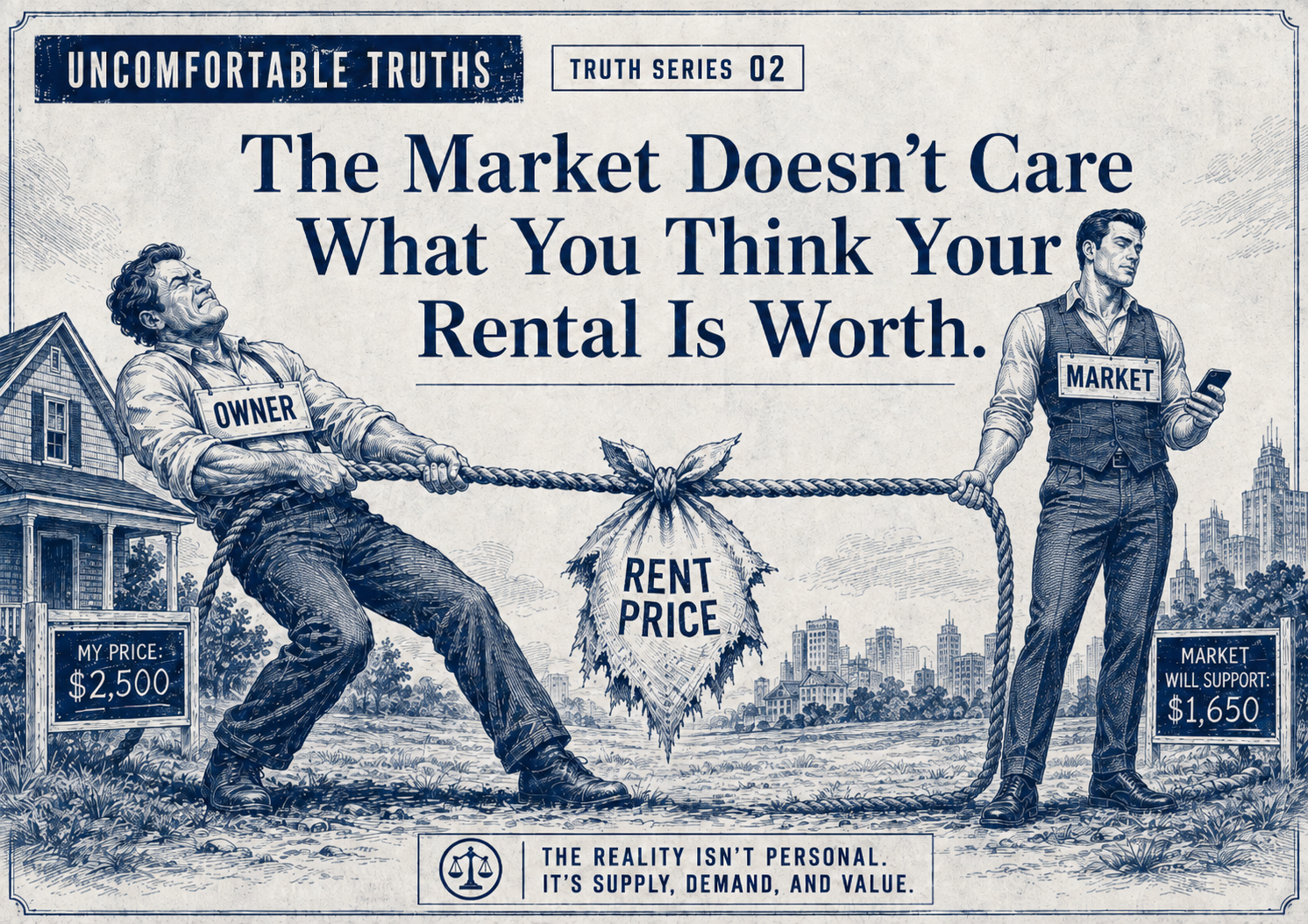
The Market Doesn’t Care What You Think Your Rental Is Worth
There is nothing wrong with believing your rental property can outperform the market. The problem starts when belief becomes a substitute for listening to what the market is actually telling you.
Most rental owners have a number in their head. Sometimes it comes from what the previous tenant paid. Sometimes it comes from another house listed nearby. Sometimes it comes from what you need the property to produce. And sometimes it comes from a very understandable belief that your house is simply better than the competition.
The uncomfortable truth is that the market does not care about any of those things by themselves. The market does not know your mortgage payment. It does not care what you paid for the house, how much the property has appreciated, or what return you are trying to achieve. A renter is comparing your property with everything else available at that moment and deciding whether the value makes sense.
That does not mean you are automatically wrong when you want to ask for more. Somebody eventually has to set the next high comp. The important distinction is knowing the difference between testing the market and ignoring it.
You can ask the market for whatever rent you want. The market is under no obligation to agree with you.
What Is the Value Proposition?
If you believe your property should rent for more than the current data suggests, one of the first questions I want to ask is:
That is not meant to tell you that you are wrong. You may know something about the property that the data does not immediately show. Maybe it has a better location, layout, storage feature, school access, backyard, renovation, or some other advantage that makes it stand out. If there is a legitimate reason a renter should pay more, we want to know what it is and make sure we are communicating it.
And sometimes my answer may simply be, “I don’t see why we can’t try it.” There is nothing wrong with testing a reasonable premium. Markets move because somebody eventually leases above yesterday’s average. But if you want to test a higher number, there should also be a second conversation: What is your fallback position if the market doesn’t agree?
Rent Growth Is Real, but It Is Not Automatic
Over time, rents in Lubbock have generally increased. Historically, we have often seen increases somewhere around the 3% range, although some periods are stronger and others are flatter. On a $1,500 monthly rent, a 3% increase is about $45. That moves the rent to roughly $1,545, not automatically to $1,650.
Could your property still lease for $1,650? Absolutely. But there should be something supporting that 10% jump. It might be improved condition, limited inventory, a stronger location, seasonality, or simply a market that has moved faster than the previous data suggests. What you want to avoid is assuming that because rents generally rise over time, your individual property should rise at the same rate every year.
The Market Changes With the Season
Timing matters, especially in Lubbock. The third and fourth quarters can often bring flatter pricing and longer days on market. A rent that may have been achievable during a stronger leasing period can become harder to get when inventory increases or renter demand slows.
This is also why you have to be careful when looking at asking rents. If another property is advertised at $1,650, that does not necessarily mean the market supports $1,650. If that property has been sitting for 50 or 60 days, it may actually be telling you the opposite. The market communicates through more than price. Days on market, showing activity, competing inventory, and how quickly similar properties are actually leasing all matter.
Home Appreciation and Rent Appreciation Are Two Different Things
Your house can go up in value without the rent increasing at the same pace because those prices are being driven by two different groups: buyers and renters.
We saw this in Lubbock around 2021 and 2022 in areas such as Revier Farm and Westchester. Buyer demand pushed home values higher, while many of those same homes were being converted into rentals. That added more rental inventory and created more competition for the same renter pool. So your property may appreciate while rent growth stays flat or slows. The rental market does not care how much the house increased in value if renters have plenty of similar options.
This Matters Even More When the Houses Look the Same
That competition becomes even more obvious in neighborhoods or built-to-rent areas where several homes have similar floor plans, square footage, finishes, and locations. If a renter has five nearly identical choices, they are going to compare price, condition, curb appeal, and overall value.
If your property is asking more, there needs to be a reason they would choose yours over the house next door. The market does not care that you paid more, owe more, or personally prefer your property. In a saturated market, it responds to the alternatives available right now.
Nice Features Do Not Always Mean Higher Rent
It is also important to separate desirability from rental premium. Granite countertops are a good example. They may absolutely help a renter choose your property over another one, but that does not mean the renter will automatically pay substantially more because the house has granite.
What you are more likely to hear is, “If I’m going to pay that much, it should at least have granite.” The granite may be helping justify the asking rent rather than increasing it. The same applies to a new roof or HVAC system. Those investments are very meaningful to you as the owner, while a renter generally assumes the roof should not leak and the air conditioning should work.
Many improvements create value, but not every improvement creates an equal increase in rent. Sometimes the return is higher rent. Sometimes it is faster leasing. Sometimes it simply keeps your property from losing to the house next door.
Your Existing Tenant May Be Paying More Than Today’s Market
You may also have an existing tenant paying more than the property would bring if it became vacant today. That can happen because rents were increased gradually over several years. A 3% or 5% increase may not be enough to convince someone to pack their house, pay moving expenses, transfer utilities, pay another deposit, change their commute, or possibly move school districts.
That means you may gradually get a tenant to $1,600 or $1,650 even if today’s vacant market would only support $1,550. That does not mean those rent increases were a mistake. You were collecting more rent while also avoiding vacancy, turnover expenses, make-ready work, leasing costs, utilities, lawn care, and the uncertainty of finding another tenant.
Sometimes the most profitable rent is not the highest rent you can advertise. It is the rent that keeps a good tenant in place.
Vacancy Is Expensive Even When It Doesn’t Feel Like an Expense
One of the easiest mistakes to make as an owner is thinking about vacancy as waiting rather than spending. Financially, there is no difference.
If your property could rent for $1,500 today but you want to hold out for $1,600, that extra $100 would produce $1,200 over an entire year. But one additional month of vacancy may already cost you $1,500 in lost rent before utilities, lawn care, repairs, or other carrying expenses are considered. It takes a long time for an extra $100 per month to recover a month of lost income.
That does not mean you should never test an aggressive rent. It means the strategy needs a stopping point. If you are going to roll the dice, decide ahead of time how long you are willing to roll it.
Be Careful When the Number Is What You Want to Hear
Pricing can easily become an exercise in confirmation bias. Maybe you focus on the two highest-priced listings because they support what you already believe and ignore the ten properties that leased for less. Or maybe you ask several property managers or Realtors for opinions until you find someone who agrees with the number you already had in mind.
There is nothing wrong with someone giving you an aggressive rental estimate. Just make sure there is something behind it. Ask what comparable leases support the number, what the current competition looks like, how long they expect it to take, and what would make them change their recommendation.
There is a difference between someone telling you, “I think we can test this higher, and here is why,” and someone simply telling you what you want to hear. Finding someone who agrees with your number does not make that number the market. The renter still gets a vote.
Your Property Manager Should Explain the Recommendation
Our management agreement gives us authority over rental pricing, but that does not mean I believe pricing decisions should happen without a conversation with you. You should understand what we are seeing and why we are recommending a price.
There may be times when I tell you that I think the rent is too high. There may be times when I agree with you and think we should push it. And there may be times when I am not convinced the higher number will work, but I do not see a reason we cannot test it.
My job is not to tell you what you want to hear, and it is not to win a pricing argument with you. My job is to explain what I believe the market is telling us, hear what you believe makes your property different, and help you understand the consequences of the decision.
If we decide to test the market, we can test it. We just need to know what we are going to do if the market gives us a different answer.
The Bottom Line
There is nothing wrong with believing your rental property is worth more. You may be right. Your property may genuinely be better than the recent comps. The market may be moving. Your house may even become the next high lease in the neighborhood.
But the market gets the final vote. It does not care what number makes your mortgage work. It does not care what the property was worth last year. It does not care that another owner is asking $200 more. And it does not care that you believe your house deserves a premium simply because it is yours.
What matters is whether a renter sees enough value to choose your property over everything else available to them. So if you want to test a higher rent, test it. Just make sure there is a reason behind it, a strategy for it, and a fallback position if it does not work.
The uncomfortable truth is not that you are wrong for asking for more. It is that eventually you have to listen when the market answers.
A rental analysis should be more than a number. We look at current competition, recent leasing activity, condition, seasonality, and the real cost of vacancy to help owners make an informed pricing decision.
Talk With Our Property Management TeamLocal Experience. Professional Management.
Why Work With Coldwell Banker Residential Property Management?
Property ownership should build value without consuming your time. Our team combines local market knowledge, clear systems, useful technology, and responsive service to protect your investment and simplify the ownership experience.
Simplified Ownership
We coordinate marketing, tenant screening, rent collection, maintenance, and compliance.
Property Expertise
Our approach is tailored to single-family homes, multifamily communities, and each owner’s plan.
Clear Communication
Owners receive timely information about leasing, property condition, and financial performance.
Useful Technology
Online portals, reporting systems, and marketing tools support efficient property operations.
Responsive Service
Technology supports the process, while attentive and accountable service remains the priority.
Local Market Strategy
Recommendations are grounded in current Lubbock rent, days on market, property condition, and neighborhood activity.
Let’s Talk About Your Property
Choose a convenient time to speak with Michael Fernuik about your goals and property-management needs.
Schedule Time with Michael Fernuik →