
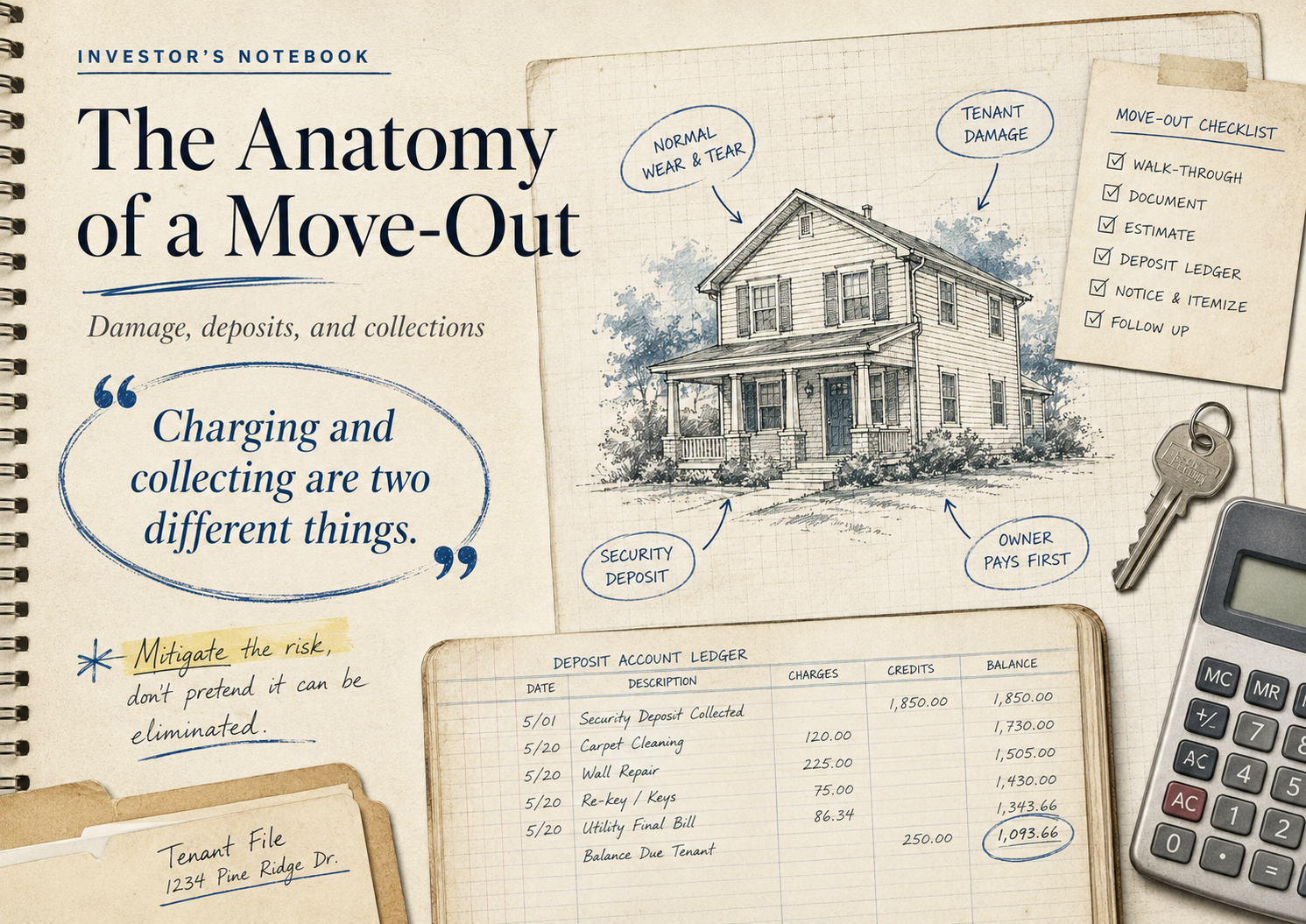
The Anatomy of a Move-Out
What owners need to understand about normal wear and tear, tenant damage, security deposits, turnover expenses, and collections.
One of the most common questions we hear after a difficult move-out is, “Why can't we charge the tenant for all of this?” Sometimes we can. The harder question is whether we can collect it. Charging a tenant and collecting from a tenant are two completely different things, and understanding that distinction is an important part of owning rental property.
A tenant can legitimately owe $4,000 after moving out. You can have photographs, invoices, move-in documentation, a lease, and a detailed accounting supporting every dollar of it. But if you are holding a $1,500 security deposit, there is still a $2,500 balance that has to come from somewhere. Maybe the tenant pays it immediately. Maybe they agree to payments. Maybe it eventually goes to collections, and sometimes you never collect all of it.
Charging a tenant and collecting from a tenant are two completely different things.
That does not necessarily mean someone mishandled the property. Rental property has risk, and the security deposit is one tool used to reduce that risk. It is not insurance against everything a tenant could possibly do to a house.
The Move-Out Actually Starts Before the Tenant Leaves
Our move-out process begins when we receive the notice to vacate. At that point, one of the first things we want to determine is whether there is an opportunity to retain the tenant. If the tenant is definitely leaving, the preliminary inspection serves another purpose. We want eyes on the property before move-out.
Are there major repairs coming? Is there something the owner needs to start financially preparing for? Is there tenant-caused damage that should be addressed while the tenant is still living there? Are we potentially walking into a larger-than-normal turnover? We are not perfect at catching everything, nor is any inspection process going to eliminate surprises. The benefit is that knowing about a problem before possession is returned gives us an opportunity to do something about it.
Once the tenant actually moves out, our property managers generally walk the property within 24 to 48 hours. We first walk it to get an overall feel for the condition. Then we use RentCheck to complete detailed documentation and compare what we see against the documentation from move-in.
The question is not simply, “What does this house look like today?” The better question is, “What changed while this tenant was responsible for the property, and why did it change?”
What Does Normal Wear and Tear Actually Mean?
Rental properties age. Paint fades because sunlight comes through the windows. People touch light switches. Carpet develops traffic patterns. Caulking deteriorates. Countertops wear. Keys wear out. Wood finishes fade. Small dings appear on trim and corners. The fact that something no longer looks brand new does not mean the tenant damaged it.
Usually Normal Wear
Minor dirt around switches, sun-faded paint, small trim dings, ordinary picture-hanging holes, aging caulk, hard-water buildup, worn keys, faded finishes, carpet traffic patterns, and ordinary material aging.
Potential Tenant Damage
Large or excessive holes, torn or burned carpet, ripped flooring, missing components, pet urine damage, neglected landscaping, or drains clogged by hair, toys, or non-flushable items.
Even small things require judgment. A few small nail holes from hanging pictures are part of someone living in a home. A wall covered with holes or excessive anchors and hardware may be something entirely different. There is no inspection form that completely removes judgment from these decisions, which is why documentation, consistency, and experience matter.
Damage Does Not Always Mean Full Replacement Cost
Suppose a tenant badly damages carpet and it has to be replaced. The tenant caused damage beyond normal wear and tear, but what if the carpet was already several years old? The owner was not entitled to receive brand-new carpet back from that tenant. The owner was entitled to receive the remaining useful life of the carpet.
Investor's note: Tenant responsibility and the price of a brand-new replacement are not necessarily the same number. Age, prior condition, and remaining useful life matter.
If older carpet was already approaching the end of its useful life, charging the tenant 100 percent of a new installation may put the owner in a better position than before the damage occurred. A reasonable bill-back should account for the age, prior condition, and remaining useful value of what was damaged.
This is also a question owners should ask before hiring a property management company. How does the company handle depreciation? How does it determine useful life? Who makes those judgment calls? A management agreement gives the property manager considerable responsibility in making exactly these kinds of decisions.
A Security Deposit Is Not the Owner's Money
I once worked with an owner who had a fundamental misunderstanding about the security deposit. In his mind, that money was effectively already his, and he wanted to figure out how to keep it.
The actual repair costs did not justify withholding the entire deposit, so he pushed us toward increasing the charges. Effectively, he wanted us to approximately double some of the repair costs so the accounting would justify keeping money that otherwise needed to be returned to the tenant.
We would not do that, and we did not manage that property for very long. That is an extreme example, but the underlying misunderstanding is worth discussing. A security deposit is not additional owner income that we need to find a reason to keep.
Our objective should never be, “How do we keep the deposit?” Ideally, we would return 100 percent of every security deposit because the tenant fulfilled the lease and returned the property appropriately. When that does not happen, the deposit is applied against legitimate obligations. We do not create or inflate charges simply to consume it.
Do Not Treat the Security Deposit Like a Running Tab
This is one reason inspections during the tenancy matter. We place considerable emphasis on quarterly inspections. Are we perfect at them? No. Sometimes something gets missed. Sometimes an inspection may not happen exactly when it should. That does not make the process pointless. The value is the opportunity to identify a problem while the tenant is still living in the property.
If we discover tenant-caused damage during the tenancy, there may be an opportunity to address it and collect the tenant-responsible expense then. Simply saying, “We'll take that out of your security deposit later,” is effectively putting the expense on the tenant's tab.
The problem is that the same deposit may eventually also be needed for unpaid rent, additional damage, cleaning obligations, or other legitimate charges. The security deposit can only be spent once.
Cleaning Is More Complicated Than It Sounds
Cleaning is one of the most subjective parts of a move-out. We recently had a property that had been cleaned extensively. It had new carpet, fresh paint, and considerable attention from the owner. The owner even sent their own cleaner because the home had special meaning to them and they wanted it presented correctly. The incoming tenants still felt it needed additional cleaning.
Were they wrong? Not necessarily. Their definition of clean was simply different. That same disagreement happens in reverse at move-out. A tenant may sincerely believe they left a house very clean while our property manager walks through it and sees work that still needs to be done.
Today, our leases require professional cleaning at move-out. We also give tenants access to vendors we know and pricing they can use. Ideally, the cleaner warranties the work so that if something is missed, the original cleaner can return and correct it instead of the tenant being charged for an entirely new cleaning.
The policy is not designed primarily to create another charge. It is designed to remove ambiguity and give the tenant a clear path to returning the property to the standard we expect.
The goal is to mitigate the risk, not pretend it can be eliminated.
The Owner Always Pays First
Another part of a difficult move-out that surprises owners is who initially pays for the work. Suppose we have $4,000 in repairs that need to be completed and there is a $1,500 security deposit. An owner may reasonably ask, “Why don't we use the $1,500 deposit and collect the remaining $2,500 from the tenant?”
The mindset owners need: When an expense has to be paid on your property, you as the owner pay it first. There is not a scenario where you do not pay it first. Our job is then to get you reimbursed from the tenant when we legitimately can.
The property cannot sit unfinished while we attempt to collect money from a former tenant. Our contractor cannot be told that a $4,000 invoice will receive $1,500 today and the balance whenever the former tenant decides to pay.
Our vendor relationships work because when we authorize a job, our vendors know they are going to get paid. That reliability helps us maintain pricing, receive priority, and expect performance in return. If the known repair scope is $4,000, we may therefore ask the owner to contribute the full $4,000.
There are also expenses that are still developing while this happens. The initial $4,000 turnover may ultimately become $4,300 or $4,600 because electricity continues to run, the grass needs to be cut, an additional cleaning item appears, or another expense occurs before the new tenant takes possession.
Tenant reimbursement cannot be the financing plan for a turnover. The owner funds the property first. Reimbursement comes second.
Not Every Expense After Move-Out Belongs to the Tenant
Owners also have to separate when an expense occurs from who is responsible for it. Re-keying is a good example. If the tenant properly gave notice, surrendered possession, and otherwise complied with the applicable lease requirements, routine re-keying between tenants is generally part of operating and turning the rental property.
That same tenant could have left several thousand dollars of legitimate damage inside the house. The existence of tenant damage does not suddenly convert every other turnover expense into a tenant charge. The damage may be billable. The normal ownership expense remains an ownership expense. Each charge has to stand on its own.
We Should Be Willing to Admit When We Are Wrong
After the move-out inspection and comparison against move-in documentation, our property manager determines which items appear to be tenant responsibility. We then begin communicating with the former tenant during the accounting process and give them an opportunity to dispute charges.
Sometimes the tenant points out something we missed. Sometimes our documentation shows that the condition existed before they moved in. Sometimes we simply made a mistake. We are not perfect, and if we are wrong, the charge needs to be corrected.
Other times we review the documentation and continue to stand behind the charge. Fairness does not mean avoiding legitimate charges. If the tenant punched a hole in the wall, being an otherwise good tenant does not make the hole disappear. But when something truly falls into a gray area, there is another question worth asking: even if we can make an argument for the charge, is the argument worth the fight?
Deposit Accounting Has a Deadline
Move-out accounting has to happen quickly. Our operational goal is to have the statement of deposit completed around the 20th day and mailed by approximately the 25th day so that we have room to correct an error or deal with an unexpected delay before the applicable statutory deadline.
That requires inspections, move-in documentation, estimates, invoices, tenant communication, and owner decisions to move quickly. Security deposit deadlines are not something to casually work toward at the last minute.
Where Deposit Accounting Ends and Debt Collection Begins
Eventually the nature of the account changes. During move-out accounting, we are determining what the tenant legitimately owes under the lease, what can be applied against the security deposit, what needs to be returned, and what balance remains.
Once those calculations are completed and the available deposit has been exhausted, an unpaid balance becomes a debt that we are attempting to collect. That distinction matters because collecting a debt has its own rules, documentation requirements, and legal framework.
The underlying lease and security deposit obligations are primarily governed by state law. Debt collection itself may also involve Texas debt collection law, and when an account is transferred to a third-party debt collector, federal consumer debt collection requirements can become particularly important.
The operational lesson is simple: the fact that someone legitimately owes money does not give an owner or management company unlimited authority over how that money is pursued. Documentation, process, and communication all matter.
Owing $2,500 Does Not Mean We Will Collect $2,500
If a tenant owes $4,000 and $1,500 is properly applied from the security deposit, the remaining $2,500 does not disappear. It remains a balance owed by the former tenant. What owners need to understand is that an account balance is not the same thing as cash.
A former tenant may pay immediately. They may enter a payment arrangement. Collections may recover part of the money much later, or the full amount may never be recovered. That uncertainty is one of the reasons an owner needs reserves. You cannot operate the property today based on money you hope somebody sends you two years from now.
“It's the Principle of the Matter” Can Get Expensive
Someone damages your house. Maybe you helped them during the tenancy. Maybe you gave them extra time or personally tried to work through an issue. Then they leave owing money or leave the property in poor condition. It feels personal because, to some extent, it is personal.
I own rental properties too. I have helped people who later took advantage of me or lied to me. I understand the business, I know the risks, and I have still been angry when it happened. Knowing better does not somehow make you immune to being frustrated.
The principle of the matter almost always costs money.
As an investor, it is not your job to teach a former tenant a lesson about what a decent person should or should not do. Pursue legitimate debt. Document it correctly. Use the collection tools available to you. But do not lose sight of the economics of the investment because you are trying to win an emotional argument.
Being upset does not automatically make you irrational. Staying upset while making the next financial decision can. Once logic leaves the decision-making process, rental property can get expensive very quickly.
A Bad Turnover Can Also Be an Opportunity
After a difficult move-out, the instinct is often to repair the damage as cheaply as possible and move on. Sometimes that is the right answer. Sometimes it is not.
Suppose we already have to put $4,000 into a property. It may be worth asking whether spending $5,000 would produce a meaningfully better rental. Maybe another $1,000 improves flooring, updates an aging fixture, addresses a cosmetic problem, or solves something that has repeatedly made the property more difficult to lease.
That additional investment might increase rent. If it does not increase rent, it may reduce days on market, which can be just as important. Make the investment because it improves the property and makes economic sense. Treat future collections as reimbursement if and when they occur.
What Should an Owner Learn From a Bad Move-Out?
After a bad move-out, we should always ask what we can learn. Was there something in the application that we did not think was important at the time but looks different in hindsight? Are we seeing a similar pattern across several difficult tenancies? Could an inspection have caught something earlier? Should a lease provision or communication process change? Would a more durable material have performed better?
Sometimes there is an operational lesson, and sometimes there is not. You can screen carefully, inspect regularly, maintain the property, use good documentation, establish clear lease expectations, and install reasonably durable materials, and eventually somebody may still damage a rental property.
The objective is not to eliminate every loss. It is to reduce how frequently losses happen, limit their severity, correctly assign responsibility, pursue legitimate reimbursement, and keep one bad experience from changing how you make investment decisions.
The best outcome after a difficult move-out is not necessarily collecting every dollar you can possibly argue for. It is getting the property back into productive condition, fairly accounting for what the tenant legitimately owes, pursuing reimbursement appropriately, learning from what happened, and making the next decision based on what improves the investment.
How does your property manager handle the gray areas of a move-out?
Property management is not just about collecting rent and finding tenants. Ask how inspections are handled, how normal wear and tear is evaluated, how depreciation is considered, when owners are expected to fund repairs, and what happens when tenant charges exceed the security deposit.
Talk With Our Property Management Team